From an Aquatic Animal Odyssey, Sydney MacDonald Reports
Sydney, a rising third-year student from the Outer Banks in North Carolina, is sending dispatches from the International Association for Aquatic Animal Medicine Conference and from a Veterinary Scholars Program research project on gamefish on the North Carolina coast.

July has been an exciting time for me to expand my summer experiences beyond the boat! Although I have spent time in the field conducting research, I have also been in a small animal clinic, volunteering and presenting.
The first week of July, I spent volunteering with individuals with mental and physical disabilities at Camp Trinity in Pine Knoll Shores. This is a week I look forward to every year because it gives me a break from veterinary medicine while allowing me to give back to a community that gave so much to me growing up. The week was spent engaging with campers and ensuring every camper had the best possible day, every single day. From blowing bubbles to singing along to favorite songs, there truly is never a dull moment.
Right after camp, I returned to Raleigh for a quick trip to give an oral presentation on the research I have been pursuing this summer. These presentations are part of the Veterinary Scholars Program and help ensure that students leave feeling confident in their ability to communicate their research in a clear and digestible way. It was exciting to learn more about all of my friends’ projects this summer and see how passionate everyone truly is about advancing veterinary medicine.
After the VSP presentations, I put my small animal scrubs back on and began a three-week externship at Mitchell Village Animal Hospital in Morehead City, North Carolina. During my time at Mitchell Village, I have had the opportunity to learn from three NC State College of Veterinary Medicine graduates: Dr. Godwin, Dr. Payne and Dr. Howard. This has been a great experience to apply the knowledge I have gained in the classroom to real-world cases.
Dr. Howard, in particular, is a new graduate who enjoys challenging me with difficult or confusing cases each day. Although I do not always know the right answer to his questions, they encourage me to think both inside and outside the box while challenging myself to apply the knowledge I have gained throughout veterinary school. Dr. Godwin and Dr. Payne have also been wonderful mentors, making sure I have the opportunity to observe unique and interesting cases throughout the hospital.
Spending time in a small animal general practice hospital is a rare opportunity for me, as I hope to pursue a career in fish medicine. However, experiences like this always remind me where I started, how I found my passion for veterinary medicine and how grateful I am for every sector of this profession.
Since starting at Mitchell Village, I have strengthened my understanding of allergies and their treatment, worked through a wide variety of dermatology cases, interpreted radiographs from tip to tail, explored canine dental health and its importance to overall wellness, and so much more. Mitchell Village has been incredibly welcoming from the moment I walked through the doors on my first day and has never questioned my skills or knowledge. Every doctor, technician, assistant and receptionist has made me feel right at home and has taken the time to get to know me as a person, not just as a veterinary student.
Although I am having a wonderful time at Mitchell Village reconnecting with my small animal roots, I am excited to begin my preceptorship with the NC Aquariums, the Karen Beasley Sea Turtle Rescue and Rehabilitation Center and the North Carolina Stranding Team on Aug. 10!
Dispatch 2: June 22, 2026

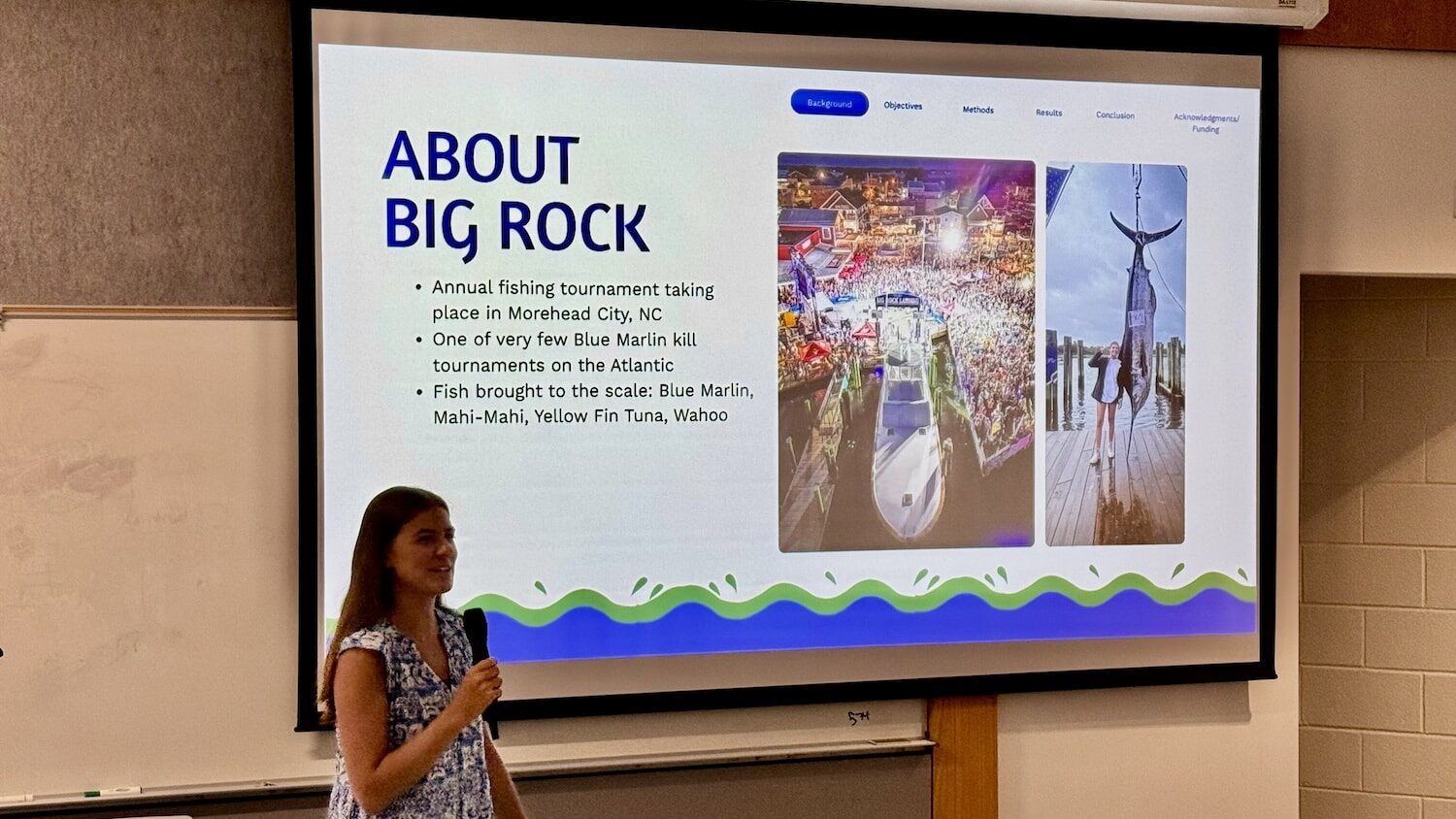
This month, I jumped headfirst back into my research at Big Rock Landing in Morehead City, North Carolina! I am working to prove that tournament-caught fish can be used for scientific data, giving scientific value to every fish that lands on the dock.
I began my fish research in conjunction with the Big Rock Blue Marlin Tournament last summer as the first, and only, veterinary student conducting research on the docks during this annual event. After a year of sharing my passion for both this tournament and my research throughout the College of Veterinary Medicine and across North Carolina and beyond, I was thrilled to welcome five veterinary students and two pre-veterinary students to the docks with me this summer for a week of unforgettable experiences and hands-on learning.
Last summer, I focused most of my efforts on mahi-mahi while also collecting samples from wahoo, yellowfin tuna and blue marlin. This year, we shifted our primary focus to wahoo and blue marlin in hopes of increasing our sample numbers and creating more opportunities for students to pursue aquatic animal research.
Dr. Greg Lewbart’s lab is now conducting health assessments on wahoo, continuing heavy metals research in mahi-mahi and diving into the current literature on blue marlin. However, we are not the only NC State researchers on the docks! Dr. Jeff Buckel, an NC State professor of applied ecology, and his lab have partnered with Big Rock and conducted research at the tournament for more than 20 years. Alongside the Buckel Lab are NC State Ph.D. students Ryan Tharp and Bethany Wager, as well as recent graduate Dr. Johnna Brooks, who work tirelessly to collect samples from every marlin brought to the weigh station.
It is always an honor to stand on the docks beside these researchers and scientists. I learn something new every day and look forward to exchanging fish knowledge with all of them. This year was especially exciting for Dr. Brooks, who received a Ph.D. in biomathematics with a concentration in fisheries ecology, whose brother brought in a record-setting blue marlin. Even more remarkably, her brother also won this tournament in 2004 alongside my very own uncle!

The Big Rock Blue Marlin Tournament is truly an event that puts North Carolina on the map and in the spotlight. At the same time, it is important to recognize that the Atlantic blue marlin is a trophy fish. Every researcher on the docks works hard each year to honor the lives of these magnificent animals and ensure that every fish brought to the weigh station contributes to scientific knowledge.
Along with all of this, I had the opportunity to attend the Nutramax Student Representative Kick-Off in Lancaster, South Carolina! During this weekend-long event, I met some of the most incredible veterinary students from across the United States and Canada. We engaged in meaningful conversations, built new connections and learned the ins and outs of Nutramax Laboratories together.
I also had the opportunity to assist with pre-release health examinations for 15 yearling loggerhead sea turtles alongside UNC’s Lohmann Lab, an incredible experience that further fueled my passion for aquatic animal medicine and conservation.
And if you couldn’t find me anywhere else over the past month, I was probably spending a beautiful day researching, teaching and learning alongside Dr. Lewbart aboard the well-known “Fish Doctor” (Dr. Lewbart’s boat)!
From blue marlin and wahoo to loggerhead sea turtles, this summer has been full of unforgettable experiences, meaningful collaborations and hands-on learning. I’m excited to see where the research takes us next.
Dispatch 1: June 5

I began my summer by traveling to Montreal, Quebec, to join some of the most incredible aquatic animal doctors from around the world at the International Association for Aquatic Animal Medicine Conference (IAAAM). During my time there, I was able to learn from many like-minded individuals about pressing topics in aquatic animal medicine such as One Health, conservation, innovation and technology, and new imaging techniques.
I also had the opportunity to present my current ongoing research at IAAAM with support from the IAAAM Medway Scholarship! The main goal of my research is to validate the use of samples from deceased wild-caught mahi-mahi (dolphin fish/ Coryphaena hippurus) to create a baseline health database for the commonly caught game fish. Mahi-mahi has a huge economic benefit for many coastal communities.
It was exciting to be able to apply the knowledge I gained in my spring marine mammal selective at NC State to the presentations at the conference, which were based on studies conducted with a variety of marine mammal species, including the California sea lion, North Atlantic right whale and common dolphin. I also was able to connect with doctors from institutions including the National Aquarium in Baltimore, the New England Aquarium in Boston, the Virginia Aquarium in Virginia Beach, and many more.
This year’s conference was hosted by the Biodome in Montreal. Being able to experience the Biodome was incredible! It is a space featuring five separate ecosystems all under one roof, housing beautiful animals from across the Americas. Although I learned a lot and was able to network with doctors from Australia, Israel, Singapore, and more, some of the most valuable connections I made were with students just like me. I became close with students from the University of Florida, Tufts University, Tuskegee University, and VetAgro Sup, an AVMA-accredited institution in France.
While in Montreal, I ate the classic sweet treat known as a BeaverTail, found the most delightful vegan poutine, made my first stop at Tim Hortons and visited too many local coffee shops to count! While I was there, the regional hockey team was playing in the NHL playoffs. I truly got to experience Montreal like a local as a group of students and I headed downtown to the Bell Centre to watch the Canadiens play Buffalo in Game 4 of the second round of the playoffs. This felt especially full circle because the Carolina Hurricanes will now face Montreal in the third round of the playoffs, which is right around the corner!

This trip would not have been possible without the incredible support of the IAAAM Medway Scholarship, the World Aquatic Veterinary Medical Association and the doctors at CMAST who supported my research endeavors, including Dr. Craig Harms, Dr. Jeff Buckel and Dr. Paul Rudershausen.
I am especially thankful for my mentor, Dr. Greg Lewbart, and his wife, Dr. Diane Deresienski. Dr. Lewbart saw my potential a year ago and has pushed me to become my best self ever since. Because he was willing to take a chance on a silly first-year veterinary student, I discovered a passion for aquatic animal medicine and look forward to contributing to this growing field throughout my education and beyond graduation.


